Way of the Cross · are a devotional that commemorates fourteen key events on day of Christ’s crucifixion. The majority surround His final journey through the streets of Jerusalem, carrying the Cross. This devotion is known both as the “Way of the Cross” (Via Crucis) and the “Way of Sorrow” (Via Dolorosa).
The ‘Stations’ are artistic works featuring the events in stone, wood, or metal; they may be sculptured or carved, or they may be merely paintings or engravings. Some Stations are valuable works of art. They are usually ranged at intervals around the walls of a church, though they are sometimes displayed in the open air (e.g. on roads leading to a shrine).
The Stations originated in medieval Europe when wars prevented Christian pilgrims from visiting the Holy Land. The object of the Stations is to help the faithful to make in spirit, as it were, a pilgrimage to the chief sites of Christ’s sufferings and death. The deviotion is prayed while passing from Station to Station, with certain prayers at each and devout meditation on the various incidents in turn. It is very usual, when the devotion is performed publicly, to sing a stanza of the Stabat Mater while passing between ‘Stations’. It has become one of the most popular of Catholic devotions, synonymous for many with Lent, Holy Week, and especially Good Friday.
—W—
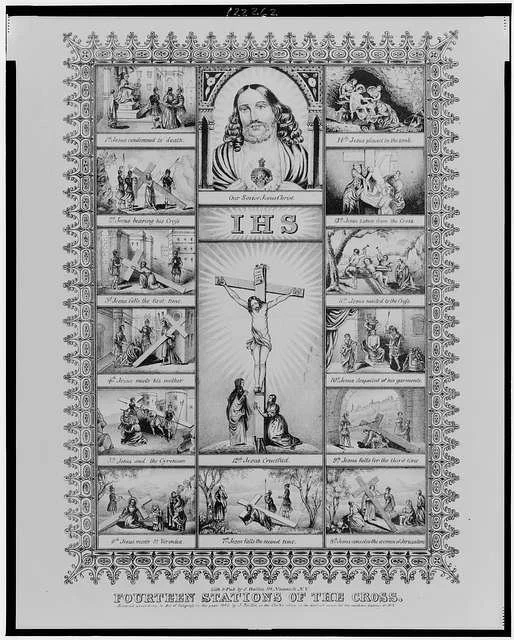
Baillie, James (19th c.). Fourteen Stations of the Cross. Library of Congress.
Witchcraft · concerns itself, like many of the magic arts, with producing some kind of effect beyond the normal natural reality; it may also specifically appeal to the occult. These days, there are still those who adhere to satanism or sorcery in overt ways. But people may also be involved in witchcraft through use of curses and hexes. It sits broadly under the umbrella of pagan practices and is not compatible with the Catholic religion or Christian faith.
Women in Ministry · is nothing new. Since the time of Jesus Himself, women have journeyed among the disciples. Mary, the Mother of God and Mary of Magdalen are also listed in the Catholic Tradition as apostles. However, and aligning with secular standards and interpretations of the same, the role of women in the life of the Church has been publicly diminished or ignored particularly since the enlightenment. As the place and value of people in society began to be
determined by money, in turn, the magnificent roles that women often played being more difficult to quantify financially, many objectified men and disproportionately idolised them from a utilitarian perspective. This diminished women and the feminine genius practically and ideologically; first- and second-wave feminism woke the world to this error.
Some are still challenged that women cannot be ordained in the Catholic Tradition; few still pursue the so-far futile hope of changing this. What can be noted is the ongoing inclusion of lay people in the governance of the Church. And, with the typical delay behind similar secular moves, the Church is recognising and promoting women to senior roles in Church governance; Pope Leo has recently made several such moves with appointments to senior Vatican positions.