Labyrinth · appears like a maze, but usually without the capacity to get lost. While pilgrimages to the Holy Land (and many a holy site) were vogue for a time, wars and restrictions on travel limited this during the Middle Ages. So, many faithful would-be pilgrim-goers set up large labyrinths in their own country. Then they could take part in a spiritual pilgrimage while walking the route to the centre or end of the course.
—L—
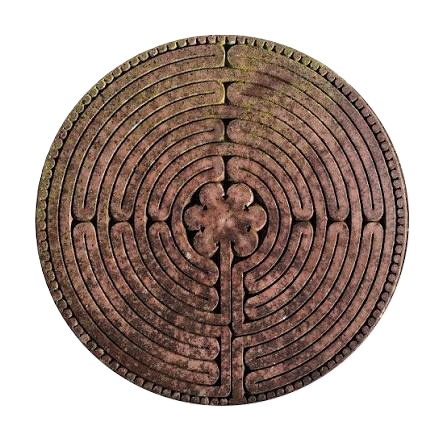
The Labyrinth at the Cathedrale of Notre-Dame de Chartres in Stein, France (Wikimedia commons).
Laicisation · simply means the reducing of persons or things having an ecclesiastical character to a lay condition. It may be done for disciplinary reasons (e.g. in response to an ecclesiastical crime) or by election of the cleric (i.e. a discernment to discontinue the practice of ministry with the possibility of pursuing another vocation). It applies to deacons, priests, and bishops permanently leaving active ministry. It may also apply at times to buildings or objects consecrated for sacred use (e.g. altars). The power to recategorize someone as lay (or ‘reduce them to the lay state’) is an exercise of the healing ministry entrusted to the Church with the ‘power of the keys’; it is for the good of souls, especially the minister-come-layman’s own soul.
Laity · as a broad term comes from the Greek work laos (λαός) as in ‘the people’ or through the adjectival form as ‘the people at large’. The Church uses it to denote God’s people — that is the baptised who form the Church. In general, it is a term for the vast majority of the Church who hold no other rank. It is used to draw a distinction between the governed (the lay) and those governing (presbyters/bishops); such a distinction has been present since Jesus singled out and commissioned the apostles. As Church hierarchy developed, it came to draw a distinction between all ordained (even subdeacon) and those not ordained. Technically, priests are a part of the laos — the people of God as a whole. But in practice the word ‘laity’ is opposed to ‘clergy’. Religious are often mistakenly considered non-lay. This is a remnant of a time they used to be considered as a third ‘state’ — where members of the Church were lay, religious, or clergy. But rightly, religious are lay unless also ordained (e.g. a Dominican priest).
From this Christian sense, the word has come to be used for those not familiar or professional in a field. For instance, I am a professional when it comes to horticulture, an amateur when it comes athletics, and a layman when it comes to health care or the practice of medicine.
Latin [language] · originated with the Roman empire and was adopted by the Western Church since the earliest centuries. It remains the official language of the Church and should have pride of place (as the default) in Roman Rite liturgies. It is especially helpful when catering to diverse or multi-national Mass attendance (e.g. Stanthorpe seasonal workers and migrants). In terms of religious anthropology, it is the sacred language of Western Christianity and much of the Western world.
Lectionary · is the book where excerpts of the Bible are ordered for the readings at Mass. This saves marking or mistaking readings, to keep the structure of the readings through the year.
Liberal arts (artes liberales) · are not ‘arts’ per se (in the modern sense) but the seven classical disciplines of learning: language, oratory, and logic;
and arithmetic, geometry, astronomy, and music. This system of traces its origins to Greek structures of thought but was formally developed through the Middle Ages. It has parallels with oriental structures of thought and teaching, and algins well with Catholic ideals for education. Many highly regarded educators of the present day use liberal arts fundamentals in their pedagogy, even without knowing or naming it.
Limbo · is the temporary state or place for souls before their final end (heaven or hell). The Church does not officially teach that limbo exists, but it is commonly held in devotion as the place where non-baptised wait for the return of Jesus. Limbo is often cited when talking about salvation for people who died before Jesus came and babies who die prior to baptism; as a place for those with original sin by no personal guilt or culpability, who we trust to God’s mercy.
Litany · is a form of responsive petition used in both public and private prayer.They usually consist of a series of names or titles for God or some heavenly being, followed by a repeated response such as “Pray for us” or “Hear us”. There is a short litany at the beginning of most Masses when the people recite the kyrie in response to the priest’s invocation. Most famous is the litany of saints used at the Easter vigil, ordinations, religious professions, and some weddings. Other litanies currently popular include the Litany of the Holy Spirit, a Litany of Humility, and the Litany to the Sacred Heart of Jesus; they are a popular practice in lent, or on feast days (e.g. Pentecost or Sacred Heart).
Liturgical Year · marked by distinct colours traces the mysteries of Jesus through each rotation of the earth. The year begins on the first Sunday of Advent and culminates on Easter Sunday (like a day begins at midnight but culminates at midday). The significance of the seasons is ordered the same as its development: First, a period of preparation for those initiated at Easter — Lent (violet/purple); and a time to celebrate the resurrection through Pentecost — Eastertide (white/gold); then similar but briefer seasons were added either side of Christmas — Advent (violet/purple) and Christmastide (white/gold); the space in between was counted in an ordinal way — Ordinary Time (green). These seasons are punctuated by feasts and solemnities relating to God or the saints.
Liturgy · literally the work of the people (from the Greek leitourgia (‘people’s work’, often on signs around roadworks in Greece) is the formal prayer of the Church. It is distinct from other prayers in that it is the official texts such as the Mass and Liturgy of the hours as opposed to composed prayers or devotionals. One does not plan liturgies; one prepares the liturgy as planned and approved by the Church authorities.
Liturgy of the Hours · see Divine Office. It is also called ‘the liturgy of the hours’ because it marks the hours of the day. This follows the charge of St Paul to “pray without ceasing” (1 Thess 5:17–18). Two primary hours (known as ‘cardinal’ hours from the Latin word which means ‘hinge’) are considered primary according to the following structure: Office of Readings (Matins) – Any time; Lauds [cardinal] (at dawn, or first thing); Terce (mid-morning); Sext (noon); None (mid-afternoon); Vespers [cardinal] (evening, or at the end of the workday); Compline (before bed, or last thing at night).
Logos (λόγος) · literally translates as ‘word (of God)’ and refers to the Jesus. From Greek philosophy and lit.
Lord’s Prayer · also known by its Latin title and opening line ‘Pater noster’ is the pattern of all prayer (St Augustine); it became known as the “Lord’s Prayer” in England just before the Reformation. It has been the basis for extensive commentary and (in)formed the structure of numerous seminal catechetical resources.
The words are drawn from the gospel of Luke 11:2–4 when Jesus was asked by the disciples how to pray; it differs minorly from the text of Matthew 6:9–15 (in the middle of the ‘sermon on the mount’). It does not seem to mimic Jewish prayers of the time but was taken up by the early Church in her prayer. It is still recited formally by the Church three times a day: in Morning Prayer (Lauds), Evening Prayer (Vespers) and at Eucharist (Mass). Many recited it often in the Rosary.
Before the rosary was a thing, beads were used by people to count recitations of the Lord’s Prayer. This was helpful for those who wished to have regular prayer in their lives but could not read (the psalms) or did not have access to printed spiritual literature. This included many monks, religious, and lay faithful.