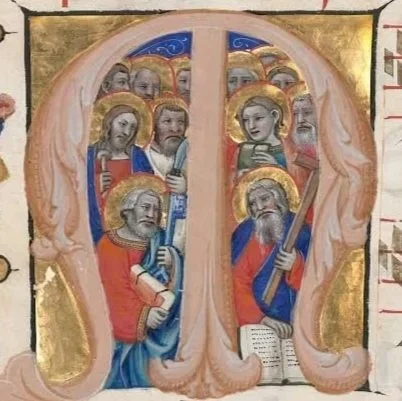
Magisterium · is the official teaching authority of the Church. This authority is not exercised executively by any one person. All bishops, in the communion that they hold as a college descendant from the apostles, teach and in the ordinary way. They exercise magisterium more formally (‘extraordinarily’) when gathered in council. The Pope usually calls the extraordinary councils either as synods or consistories; he then speaks for the combined and united voice of the bishops, and with their shared authority (not some personal authority as pontiff) in his encyclicals (letters).
Man(kind) [in language] · is synonymous with ‘human’ in most Church use. These days, with sensitivities heightened, many texts will speak of ‘a person’ or ‘human’ instead.
Marian Devotion · involves the honouring of Mary as mother of God. It does not pay homage to her as to God, but recognises her as God’s chosen, the model disciple, and as having a special care for us. The devotion was important in Australia during early years when there were no priests and the public practice of the faith was forbidden.
Marriage (natural) · is the free coming together of two persons to a life-long and exclusive relationship. Typically, this has been recognised when a man and a woman unite and start a family. The Church recognises all natural marriages that meet its own essential criteria. Non-Catholics marriages by almost any form or rite are recognised to be valid (though not sacramental if one is unbaptised). De facto relationships can be a natural marriage.
Marriage (Sacrament) · emerged somewhat late on the scene (during the Middle Ages). As a sacrament, it makes present and points toward both the relationship within the godhead and the relationship of the godhead with humanity. There are four essential dimensions (‘goods’) of marriage for Catholics: An openness to life (the relationship is not self-serving or self-centred), emotional and physical fidelity (as the 1961 Australian Marriage Act puts it: ‘to the exclusion of all other’), (mortal) permanence (essentially that we do not believe in ‘no fault divorce’), and mutual good (that the couple support each other to grow in their humanity and sanctity).
Martyr · literally means ‘witness’. One might witness in the extraordinary way through the ultimate sacrifice for the faith. But all are called to witness daily – in the ordinary.
Mass · is the common term for the celebration of the sacred mysteries. Some traditions refer to it as ‘eucharist’ or ‘divine liturgy’, and many Catholics add the adjective as in ‘Holy Mass’. The origin of the term was covered in the entry on Ita missa est.
Mass (intention) · is the person (living or dead) or petition for which a Mass is offered. On Sundays, pastors pray a Mass pro populo; that is, ‘for the people’ of their parish(es). Other than this Sunday Mass, and with some exceptions, priests can celebrate Mass for an intention requested of them. If they receive too many requests, they send them to priests in mission countries or less active parishes.
Mass (offering) · refers to the monetary offering made a priest to offer the Mass for a specific intention (as above). In Australia, this is usually $10 or $20 during November (for the holy souls) per Mass. Most priests will offer a Mass for an intention requested, even if the person requesting cannot provide an offering.
As money is involved, there are rules. Priests may only receive the monies for one Mass intention per day. Any more monies for additional intentions or additional Masses must be surrendered according to local Diocesan policy (in our case, sent for contribution to the vocations/formation funds). In the case the priest receives too many Mass offerings, he can send and delegate them (including funds) to communities of missionary priests so that Masses will still be said for the intentions and the funds support their work. Priests must also keep carful record of offerings received and Masses offered to account for their following of these rules.
Mercy (works of) · are divided into two categories — corporal and spiritual — with seven in each, traditionally expressed as: feed the hungry, give water to the thirsty, clothe the naked, shelter the homeless, visit the sick, visit the imprisoned (or ransom the captive), and bury the dead; instruct the ignorant, counsel the doubtful, admonish the sinners, bear patiently with wrongdoing, forgive offenses, comfort the afflicted, and pray for the living and the dead. These are traditionally considered the honourable and meritorious ways for Christians to show and reflect the mercy they have received. Theologically they are a means of grace, atone for (make up for) sin, and help the person doing them to grow in charity (Christian love).
A contemporary expression of the same corporal and spiritual works include: provide for the poor, give water to the thirsty, honour the dignity of those exposed, shelter those without friends/company, spend time with the sick, visit those isolated or imprisoned, and attend funerals; speak truth (with charity) to the naïve, bring hope to the doubtful, speak up in the face of wrong, be patient, forgive first, comfort the troubled, and pray for others (living and the dead). Faith without works is dead (c.f. James 2:17 & 2:26). These works align with and have been known to support a life of faith and ongoing conversion.
Missal · is the book of prayers and excerpts from scripture for use at Mass. The altar missal has only the prayers for Mass, while hand missals have the prayers for the Mass as well as the readings for weekdays and Sundays in separate volumes.
Mission · literally ‘sent’. It is critical that Christ was sent into the world and that Christians follow in His footsteps in that they are also on mission in the world. Mission is more than Matthew 28 and ties into the Mission of God all through salvation history. Mission can be carried out extraordinarily in so-called mission trips or ordinarily by living out the apostolate while always being ready to give account for hope and what faith offers (c.f. 1 Peter 3:15). Noone is not sent; not all are sent the same.
Modesty · is an extension of the virtue of temperance. Modesty is not achieved through covering up alone but through appropriately treating goods and the self with respect and dignity. Modesty is a kind of internal moderation expressed in external behaviour, all guided by the umbrella virtue of temperance.
Men have, for centuries, used modesty as a form of complaint (and control) against women. The latter can certainly be moderate/temperate in what they wear (what they are showing off, be it of themselves or their accessories), but perceived provocative dressing is at least as much a failing on the part of the perceiver and structures of culture as one who exhibits it. In fact, it is often men who need to be moderate/temperate in the way they view or talk about women. When one is immodest about one’s body, belongings, or achievements, there is a high risk of pride and/or judgement of others. One can be as immodest boasting of wealth with a designer item as showing off or displaying physique.
Monks · are members of religious communities leading a more contemplative life. They live the vows of poverty, chastity, and obedience according to a rule of the order to which they belong. Technically, the Church does use the term ‘monk’; it is a colloquial umbrella term for the more ruminative of the orders, especially the hermits and quieter religious brothers (none take a vow of silence — a common misconception).
Monsignor · literally ‘my lord’ from the French. Some places in the world it is the style for bishops. In formal Church language, it is an honour given to priests who work in the Vatican for more than five years or more senior priests who are named honorary bishops for their service to the Church.